Multi-Location Beauty Brand · Barbershops & Beauty · 45 days to launch
A $30M-a-Year Beauty Brand, Running on Software It Owns
One of our clients, a multi-location beauty industry brand running a $30M-a-year operation across South Florida, had its booking, payments, payroll and reports spread across rented tools. In 45 days we replaced all of it with Papos, one platform the brand owns, and cut more than $700K a year in software and merchant fees.
What we built
The challenge
The brand was strong, but the software behind it was rented. The booking app carried another company's name, the platform owned the client data, payments and software fees grew with every new location, and calls went unanswered at peak hours. Leadership wanted one system with their own name on it that could enforce their business rules everywhere and grow with the brand.
What we did
- Rebuilt the website on the brand's own domain with a page for every location, a live 'open now' finder and online booking, and kept every old address working.
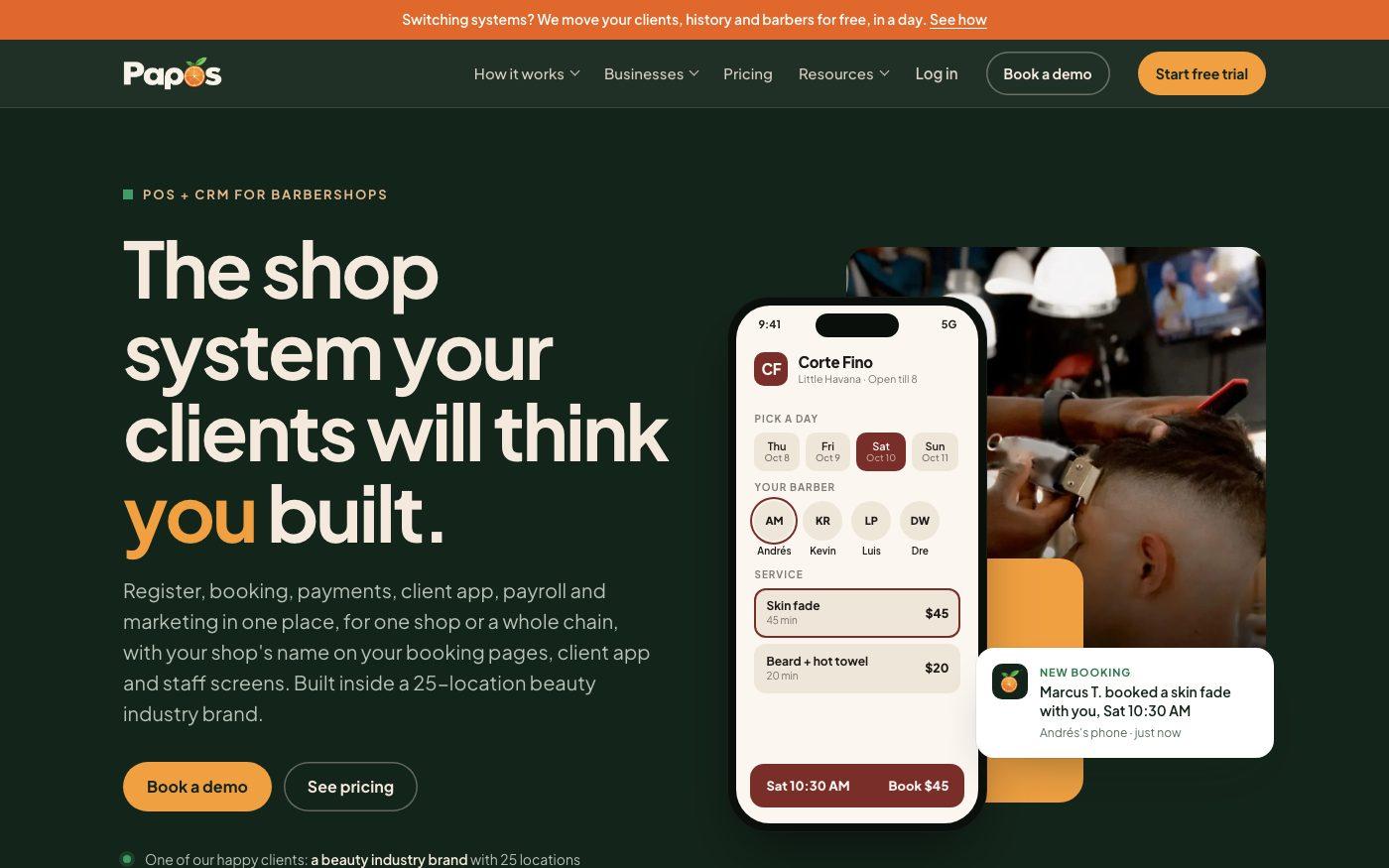
- Built the client app with booking, loyalty points and memberships, and a team app with calendars, live arrival alerts, commissions and clock-in.
- Built the register and executive dashboard: checkout, cash drawers, payroll with tiers and tip rules, gift cards and reporting across every location.
- Deployed a bilingual English and Spanish AI phone receptionist that answers every call, finds the right professional, books the visit and texts the confirmation.
- Moved the full client history over with no duplicates and moved card processing to negotiated rates, which is where most of the yearly savings come from.
- Made the brand easy for AI assistants to read and recommend, in English and Spanish.
The outcome
Every location moved off the legacy platform and onto Papos within 45 days. The brand now owns its client data, its rules and its app, missed calls become booked visits, and it saves more than $700K a year in software and merchant fees. The same platform is now offered to other brands as Papos.
Reference architecture
How the platform and its AI fit together.
Phone in English and Spanish, web booking, the client app on iOS and Android, team and manager apps, and in-store iPads.
A phone receptionist that books and confirms, a staff assistant scoped to each role, and a read-only owner reporting agent.
Sign-in scope, a server-side field filter, a fixed set of tools, an answer check, and logs with usage caps and an off switch.
Booking, payments through Stripe, payroll and tips, client history and executive reporting.
An isolated store for each client, full audit logs, and the AI model running behind the guardrails, never in front of them.
Governance
Guardrails live in code, not in prompts.
Every request carries the user's role. The agent only acts for that person.
The server removes rows and fields the user may not see before the model sees anything.
Agents call a short list of approved tools, read-only unless a write is approved.
Every booking carries a unique key, so a retried request can never book twice.
Full logs, daily usage caps and an off switch on every deployment.
Evaluation
How we tested the AI receptionist before and after launch.
We ran it on our own sales line first, then stress-tested it with simulated callers and live test calls against the real booking system: named and any-available bookings, misheard names, callers switching between English and Spanish, either-or questions, returning callers, moves, cancellations, closed hours and slow lookups.
Book, move or cancel only after the caller confirms the details. Read availability from the live calendar, never guess. Apply the client's own cancellation policy. When unsure, take a message or hand the call to the team.
The stress round caught language switching mid-call, wrong staff matches, unanswered either-or questions and a usage cap that missed calls in progress. The client rollout waited until each was fixed and re-tested.
Automated test suites for guardrails, routing, latency, consent, data scope and recovery run on every change. Releases go out in planned windows with a full backup, no live calls and a ready rollback.
Production issues are reproduced, fixed, pinned by a test, released and confirmed on live calls. After a model-provider outage we added spoken recovery and a team-or-voicemail fallback, so a caller always reaches a person or leaves a message.
Want results like this?
An engineer looks at your calls, leads and software, shows where AI pays off, and gives you a fixed quote.